What is the best transparent plastic for food and drink applications?
Joshua Heck
European Product Manager Advanced Styrenics, Ultrapolymers
In the current food and drink market, plastics face real scrutiny, driven by consumers becoming increasingly aware of microplastics and leaching chemicals, and by increasingly stringent regulations.
After extensive review, the EU has banned Bisphenol A (BPA) and other endocrine-disrupting substances from food-contact applications, enforced under the European REACH (Registration, Evaluation, Authorisation and Restriction of Chemicals) law and the US-governed FDA (Food and Drug Administration). At the same time, EU Regulation 10/2011 for plastics in contact with food and the new EU Drinking Water Directive (DWD) set further restrictions on chemicals and materials permitted in food- and drinking-water-contact products, with strict migration testing the market has never seen before.
Together, these have pushed BPA-based polymers such as polycarbonate (PC) out of food and drink applications, leaving designers and brand owners searching for the next-best transparent, food- and drink-safe material that meets regulations without compromising the glass-like look consumers expect. But what is that next-best material?
The main BPA-free transparent plastics used in the food and drink market today
PETG (Glycol-modified PET)
PETG, from the PET family, is an amorphous, toughened, transparent material with good chemical resistance, durability and ease of processing. This balance of properties makes PETG ideal for reusable containers, food packaging, drink containers and retail display packaging.
PETG has relatively low heat resistance and can be softer than other engineering plastics, making it unsuitable for structural applications and susceptible to scratching from daily use or repeated dishwasher exposure.
An important consideration is that these materials do come with a slight price premium over some other solutions.
PP (Polypropylene)
Polypropylene is valued for its chemical resistance, cost-effectiveness and ease of processing. Random Copolymer polypropylene (PP-R) is semi-crystalline yet transparent, thanks to its copolymerisation with ethylene, which produces a more complex, less regular molecular structure. Thanks to this balance of properties, PP copolymer has become increasingly popular in reusable food storage containers and closures.
Though it offers transparency, even clarified grades typically do not achieve the transparency of amorphous materials. In addition, PP doesn’t match the mechanical or thermal performance of engineering materials.
PMMA (Acrylic)
Also known as acrylic, PMMA is an amorphous engineering material that delivers excellent optical clarity and glass-like transparency for a premium aesthetic. This makes PMMA successful in beverage dispensers, retail and hospitality equipment, and reusable drinkware.
PMMA has an excellent tensile strength but is brittle; therefore, it is not suited to applications where drops and impacts are likely. PMMA is hydrophobic but still absorbs water over time; therefore, it requires, like some other materials, drying before moulding, adding complexity to the manufacturing process.
PPSU (Polyphenylsulphone)
From the polysulphone family, known for performance in extreme environments, PPSU delivers outstanding heat resistance, chemical resistance and durability. This material’s ability to retain transparency even under harsh conditions is why PPSU is used in reusable baby bottles, coffee machine components, professional catering equipment, and high-temperature food-contact products.
PPSU is a specialist material that comes with a high material cost. Though transparent, it has an amber tint, unlike the glass-like clarity of PMMA.
SAN, SMMA & MABS (Styrenic Copolymers)
Styrenic copolymers offer some well-rounded solutions that tick the boxes of crystal-clear clarity, durability, chemical resistance, processability, regulatory compliance, and cost-effectiveness. Thanks to this blend of attributes, they are becoming more and more popular in a variety of household and industrial food- and drink-contact applications
Where styrenic copolymers are the clear winners
General-purpose styrene (GPPS), also known as crystal styrene, is a highly cost-effective material produced in significant volumes. However, it has its shortcomings, including brittleness, limited resistance to organic chemicals, and softening at relatively low temperatures. Styrenic copolymers offer a performance upgrade, combining the benefits of styrene with the attributes of other monomers to create polymers with a blend of desirable properties.
Many transparent plastics excel in one area but compromise in another. PMMA offers exceptional clarity but limited toughness. PPSU offers excellent durability but at a premium price. PETG typically offers superior chemical resistance, but it may not deliver the required rigidity or scratch resistance. Styrenic copolymers can provide a perfect balance.
SMMA, such as NAS® from INEOS Styrolution, is a copolymer of styrene and methyl methacrylate; the latter being what also makes PMMA (acrylic). SMMA is an engineering material with a balance of strength and stiffness, water-clear clarity, aesthetic appearance and good chemical resistance. It is often selected where aesthetics and water-clear visibility are important, such as in food storage containers, water filters, water reservoirs, injector pens and cosmetic jars.
MBS, such as Zylar® from INEOS Styrolution, is a copolymer of methyl methacrylate, butadiene and styrene. This is similar chemistry to SMMA, with the addition of butadiene rubber. The result is a high-surface-quality polymer that combines transparency, increased toughness, and easy processing. MBS is often used where visual appeal and durability are needed together, such as in household devices, transparent toys, medical equipment and office supplies.
Five food and drink applications benefiting from styrenic materials
1. Food display cloche
Food retailers and bakeries need covers that showcase products while surviving everyday handling and cleaning. Glass can be heavy, expensive and prone to breaking, creating a hazard for the user to resolve.
NAS® SMMA offers a crystal-clear appearance with reduced weight and improved durability.
2. Coffee machine water reservoir
On a coffee machine, consumers want to see the water level reservoir clearly, while manufacturers need materials that withstand repeated exposure to warm water and cleaning agents. The challenge is finding a material that meets the needed thermal and chemical performance while delivering the desired aesthetic over the entire lifetime of the coffee machine.
NAS® SMMA offers the perfect combination of transparency, thermal stability, dimensional stability and durability.
3. Sports bottles & reusable drinkware
Reusable drinkware needs to survive a bag, a car floor and a toddler's drops while still looking good after months of use. Finding a balance of clarity and toughness is the challenge for these kinds of products.
Zylar® MBS provides excellent impact resistance to withstand drops and knocks in daily use, combined with a lightweight, glass-clear finish.
4. Food storage containers
Consumers at home and caterers in restaurants need to identify a container's contents quickly, without opening the lid, helping to store food effectively and reduce waste. The containers must also withstand repeated use and wash cycles without warping, clouding or staining.
NAS® SMMA or Zylar® MBS are tried-and-trusted solutions for these applications, delivering transparency for contents visibility, chemical resistance to food oils and acids, and dishwasher-safe durability.
5. Premium food preparation equipment
Food processors, blenders, mixers, and other kitchen appliances for home and commercial environments often have transparent housings, lids, guards, or ingredient reservoirs. These must withstand daily mechanical stress and cleaning while retaining performance and a premium look for the product's lifetime.
NAS® SMMA or Zylar® MBS deliver a high-end, glass-like aesthetic whilst providing durability, dimensional stability and chemical resistance for long-term performance.
What is the best transparent plastic?
The honest answer is, there isn’t one. The right transparent plastic depends on the application’s requirements, the temperature range it will be exposed to, whether it’s intended to be single-use or reusable, the final aesthetic that needs to be achieved, what chemicals it will come into contact with, which regulations it needs to comply with, and last but not least, cost.
This is where material selection becomes critical. Our team draws on experience placing materials in countless applications, plus close supplier relationships, to compare options against your product's requirements.
Replacing polycarbonate in a food or drink product?
Tell us about your application, temperature range and cleaning conditions. Our team can help you identify suitable material options.
Conclusion
The "best" transparent plastic is the one that's right for your product. PETG, PP, PMMA and PPSU are excellent candidates for many applications, and styrenic copolymers have earned their place as genuinely strong all-rounders for products that need clarity, toughness, thermal stability, chemical resistance and processability.
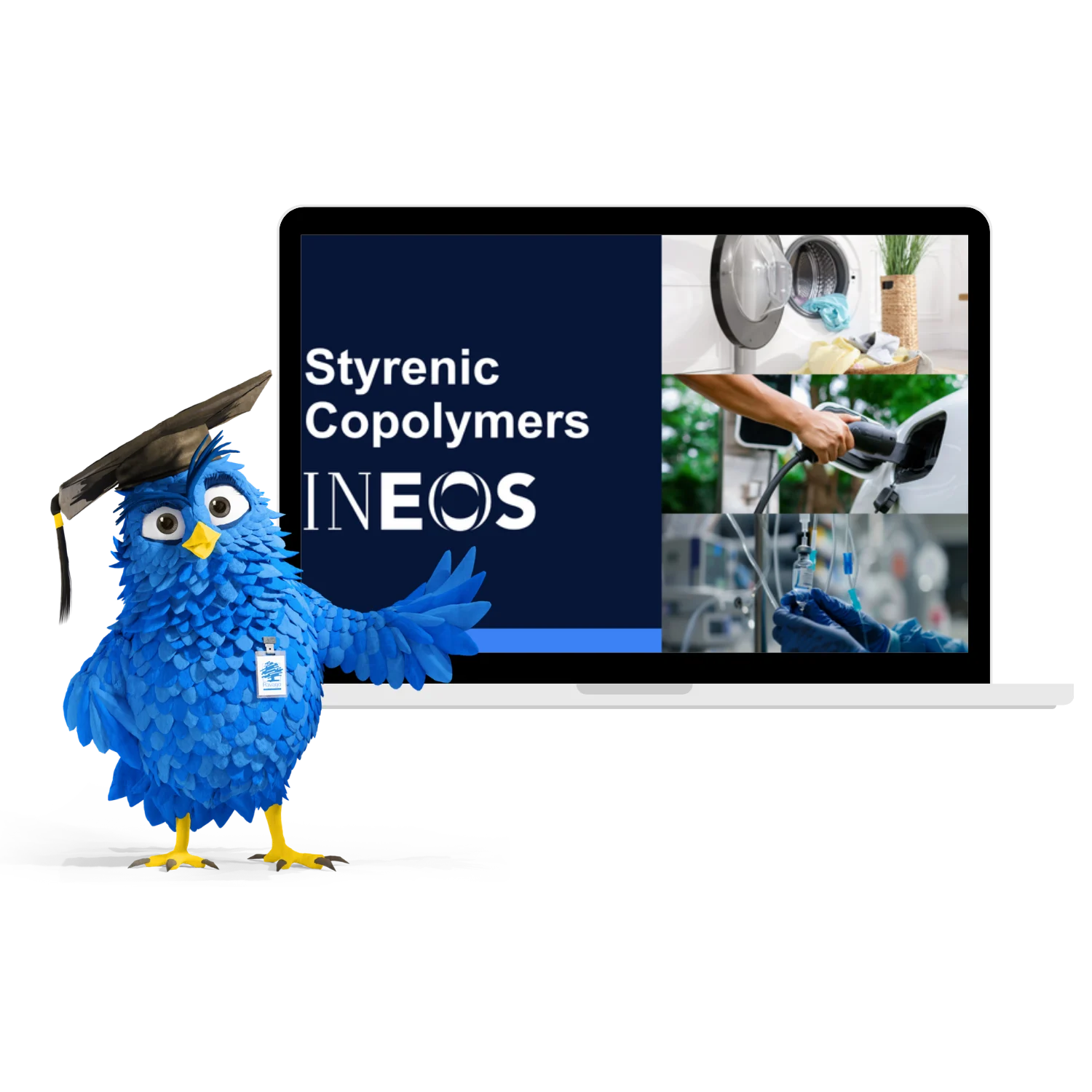
Beyond Polystyrene: Styrenic Copolymers Explained
Understand the differences between the most important styrenic copolymer families
Discover the science and practical uses of styrenic copolymers, including SAN, ABS, ASA, SBCs and more. Learn how composition affects performance, compare key material families, and explore the applications that make styrenics a cornerstone of modern product design and manufacturing.To support you on this journey Ultrapolymers have collaborated with DOMO, producer of Technyl® polyamides, with an online course to support you in this process.
For pending registrations: you will receive an email to access more content once your account has been verified
FAQ
Choosing a tranparent plastic for your product?
Speak to Joshua about your application, operating temperatures and cleaning requirements.
joshua.heck@ultrapolymers.com