How to incorporate recycled content into barrier films, without compromise
Polina Salnikova
European Product Manager, SK
Ultrapolymers
Polina is Ultrapolymers’ European Product Manager, with a strong background in polymer science and experience spanning flexible packaging, compounding, wire & cable (W&C), and other extrusion‑based applications. She has supported processors in optimising material formulations and production performance across diverse industries, enabling them to bring innovative, high‑quality film solutions to market.
Prefer to listen to the audio version of this article?
Sustainability initiatives across Europe are intensifying with upcoming EU regulations, such as the PPWR (Packaging and Packaging Waste Regulation). For film producers and brand owners alike, the conversation has shifted from if recycled content should be used to how it can be implemented rapidly and reliably without putting performance or brand reputation at risk.
SK Functional Polymer is a pioneering developer of additives with a strong track record across compounding and film applications, continuously advancing materials that enable high‑performance and recycled‑content packaging solutions.
This article shares practical, industrially proven learnings from a real case study, supported by SK Functional Polymer, demonstrating, step-by-step, how to incorporate recycled content into barrier blown films.
Understanding the Challenge: Recycled Content in High-Performance Film Structures
In theory, introducing recycled content to film structures sounds straightforward. In practice, it remains one of the most technically challenging topics in flexible packaging.
Why is recycled content difficult to incorporate?
Most high-performance packaging films are engineered systems, not simple materials. For the seemingly simple, everyday products we see in supermarkets and the home, a combination of several materials or more is required to achieve the desired performance:
- Polyethylene (PE) layers for processability and sealing performance,
- Barrier materials such as EVOH for oxygen barrier properties,
- Tie layers and additives to optimise adhesion, optics, and mechanical strength.
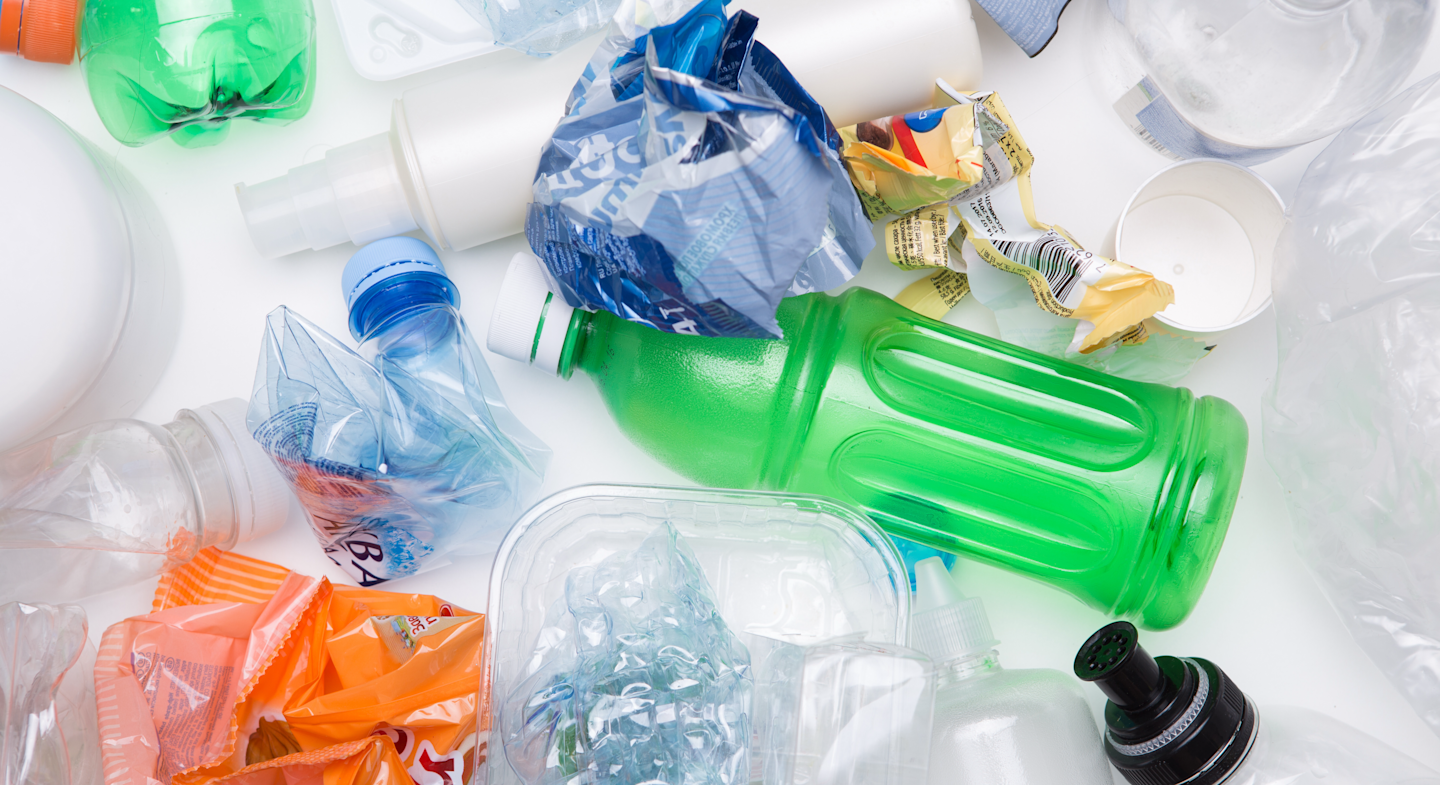
The mechanical recycling process mixes these materials together, meaning the PCR (post-consumer recycled) materials you buy will behave differently than the prime starting blocks you are used to. It’s important to say at this point that no two recycled materials are made equal. The quality of your PCR will depend on the feedstocks, how the waste is sorted, the intensity of the cleaning process, the temperatures at which it is compounded back into granules, the filters used, etc.
How do you make PCR film compatible with existing film production processes?
Recycled materials introduce variability. With feedstocks often coming from various sources, the resulting polymer can have an inconsistent melt flow rate, residual contamination or gels, colour and odour variation, or residual additives. From a processing perspective, this introduces three core risks:
- Process instability: Variability in recycled materials can affect melt strength, bubble stability, and gauge control.
- Loss of functional performance: Barrier properties and mechanical strength must remain consistent for the end product to function properly.
- Aesthetic compromise: Haze, gels, colour shift, or surface defects are unacceptable, particularly for branded or downguaged packaging.
These risks are more pronounced in multilayer barrier films, where different polymers must work together as a single system.
Case Study Insight: Maintaining Film Quality at 30% Recycled Content
In this example, what the customer needed was a solution to produce a multilayer barrier film with recycled content. Through incorporating recycled material, there could be no compromise in mechanical strength, barrier performance or optical quality. Plus, the material had to be easy to incorporate into an existing industrial 9-layer blown film extrusion line.
Why PE-EVOH Polarity Matters when Adding Recycled Content
As described earlier, films incorporate multiple layers of slightly different materials that bring different properties to produce a high-performance system. Continuing with the example of PE and EVOH, this combination of materials is great for the recyclability of the product, as PE and EVOH come from the same polymer family, polyethylene. However, EVOH is polar, whereas PE is not. This is problematic when making films because like attracts like.
Polyolefins, including polyethylene (PE) and polypropylene (PP), are non-polar. EVOH, however, is polar, which makes it less compatible with PE.
When a film contains recycled content that includes both PE and EVOH, this polarity difference can manifest during processing as weaker interlayer adhesion, increased risk of delamination, optical defects such as haze, or inconsistent barrier performance.
How LOTADER® 4210 Compatibiliser Enables Recycled Content
Compatibilisers containing MAH (maleic anhydride) help bridge the polarity gap between materials like PE and EVOH by providing an attractive medium for both materials.
LOTADER® 4210 is a random ethylene-butyl acrylate-maleic anhydride terpolymer. In plain English, that means it is a highly functional compatibiliser containing high levels of MAH. This material from SK Functional Polymer is used for all sorts of applications, compatibilising different polymer blends, acting as an adhesive to metallic substrates, or used as a tie-layer in extrusion coating processes.
Incorporating LOTADER® 4210 into the recycled material made the:
- recycled content easier to process,
- film structure behave more like a virgin/prime formulation,
- and better preserved the aesthetics.
This ticked all the boxes for the customer, enabling them to:
- incorporate 30% recycled content into films,
- maintain production efficiency,
- and deliver consistent, high-quality packaging.
This case study shows that when compatibility is engineered correctly, recycled content can be added without compromising film performance, even in demanding barrier films.
Achieving 30% Recycled Content in PE/EVOH Barrier Structures
While every film structure is different, several best practices apply across blow and cast barrier film production.
Prioritise process stability
Theory is one thing, but practicality is something else. Trial PCR on your production line, and monitor pressure, temperature and output consistency. Ensure you trial multiple batches and validate reel-to-reel consistency, not just short trial runs.
Pick the right partner
As described before, no two PCR feedstocks are equal, which is why selecting your supplier is critical for success. Make sure to choose a supply partner that gives you options, can provide a tailored solution and support you from design, into material trials, testing, and troubleshooting.
Conclusion:
The key learning from the project was the importance of compatibilisation. In multilayer systems, even monomaterial films, where all layers are from the same polymer family, incompatibilities can arise when incorporating recycled content. Therefore, without intervention, recycled blends suffer from poor morphology and weak interfaces.
This case study shows how compatibility can be achieved in one simple step and that recycled content can be integrated into high-performance films without sacrificing quality or efficiency.
At Ultrapolymers, we support film processors by finding practical, scalable solutions. Our close supplier partnerships with producers like SK Functional Polymers mean we can help customers:
- incorporate recycled content into their products with confidence,
- maintain product quality and processing stability,
- and build pathways toward a more circular future.
If you are a film processor looking to incorporate recycled content into barrier or multilayer films, we’re ready to support you.