

Recyclability isn’t the hard part of PPWR. Recycled content is.
What flexible-packaging converters need to do now to be ready for 2030
Michael Seegmüller
Segment Leader, Film & Lightweight, Ultrapolymers
For most flexible-packaging converters, designing a recyclable structure is achievable. Recycled content is the harder task. You have to secure enough post-consumer recycled (PCR) material, get it to run on your lines and prove that the film still performs at a competitive cost and with a supply you can rely on. That work needs to start now.
In brief
- From 2030, packaging placed on the EU market must reach recyclability grade C or better, and plastic packaging must contain a minimum share of post-consumer recycled plastic.
- For film, the key minimums are 35% for most plastic packaging and 10% for contact-sensitive packaging, such as food packaging, that is not made from PET.
- Recycled content depends on the whole formulation. A grade containing 70% PCR, used at 30% of the film, gives about 21%.
- The calculation rules are not final, and the 2030 date could slip by some months. Development and validation take longer than that, so waiting is the bigger risk.
Why 2030 is closer than it looks
Getting a solution ready for 2030 sounds like you have plenty of time, however it isn't. In that window a converter must select materials, secure supply, run trials, and validate the finished structure, while keeping the processability and performance the customer expects.
Most of the film producers I speak to know that PPWR is coming. The uncertainty sits further downstream. I recently visited a large extrusion-coating producer making paper and aluminium laminates, and their message was clear. For now, nothing has changed for them, and many of their customers don’t want to change a structure that works. The risk is that brand owners wait, then ask for something different almost overnight. Converters would then face a wave of requests with too little time to develop and validate solutions.
What does PPWR require?
The Packaging and Packaging Waste Regulation (PPWR), Regulation (EU) 2025/40, replaces the old Packaging Directive with a single set of rules for all packaging placed on the EU market. It entered into force on 11 February 2025 and has applied since 12 August 2026. Some obligations are already in place, including limits on PFAS in food-contact packaging and the need for a declaration of conformity. The requirements that will reshape film structures come later.
For film producers, two requirements matter most. Both are due to apply from 1 January 2030.
• Recyclability. Packaging must be designed for recycling and reach recyclability grade A, B or C. Grade C means at least 70% recyclable by weight. Packaging below that cannot be placed on the market. From 2038, only grades A and B (at least 80%) will be allowed, so a structure that only just reaches grade C has a short life. The detailed design-for-recycling criteria are due by 1 January 2028.
• Recycled content. The plastic part of packaging must contain a minimum share of recycled plastic. Only material recovered from post-consumer waste counts. Post-industrial material, such as production scrap, does not.
The minimum depends on the type of packaging:
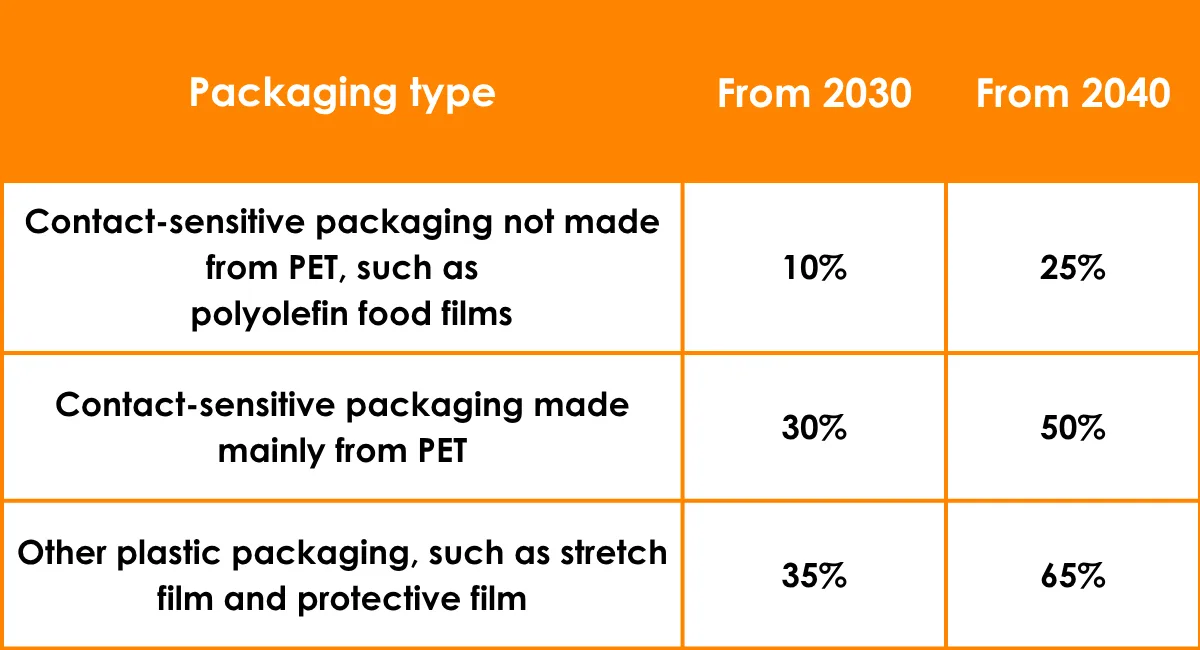
Three details matter in practice:
• The minimum is not a company-wide average. It is set per packaging type and format, and calculated as an average per manufacturing plant and year.
• Some packaging is exempt. Examples are compostable plastic packaging, packaging in direct contact with medicines, contact-sensitive packaging for food made only for infants and young children, and any plastic part that makes up less than 5% of the total weight of the pack.
• The method and the date are not final. The European Commission must set the method for calculating and verifying recycled content by 31 December 2026. The targets then apply from 1 January 2030, or three years after the method enters into force if that is later. A call for evidence closed in September 2026, and some in the industry expect a delay. Check the final method when it is published rather than relying on the headline percentages.
So the first step is to establish which category each of your packs falls into.
The two requirements are connected but different. A pack can be recyclable without containing any recycled material, and adding PCR does not make a pack recyclable. Converters need to solve both.
Which structures are most exposed
The structures that need the closest review are those that combine materials which cannot easily be separated after use.
Aluminium foil bonded to polyolefins is the clearest case. Earlier this year I visited a producer of pet food trays made this way. The tie layer does exactly what it is designed to do, which is to make the two materials inseparable. The structure performs very well. But the bond that makes it work is also what counts against it in a recyclability assessment. A thin metallised layer is generally treated more leniently than foil in current design-for-recycling guidelines, but it still needs to be checked.
Structures that combine different polymer chemistries also need close review. Adding a PET top layer for printability or gloss introduces a second chemistry into a polyolefin structure. Children’s fruit-purée pouches are the obvious example: typically polyester on the outside, sometimes with a metallised layer inside. Both choices are rational on their own terms. Together, they make recycling more difficult.
Paper-based laminates are in better shape than most people assume. Paper has mature collection and recycling chains behind it, and paper fibre is easier to separate from a laminate than two bonded plastics are. The recycled-content minimums apply only to the plastic part of a pack, and a plastic part below 5% of the pack’s total weight is exempt. The recyclability grade will still depend on how much plastic or aluminium the paper carries.
Where a barrier is unavoidable, the practical route is to keep the minority components low enough that the film still counts as mono-material. Current industry guidelines such as RecyClass accept EVOH in a polyethylene film at up to 5% by weight, when it is used with a suitable tie layer. Polyamide is treated more strictly, and most grades are classed as not compatible. The PPWR criteria may differ when they are published, so treat these figures as a guide.
I expect tie layers to stay virgin. They are normally used only as a minor component of the film, so there is little benefit in developing a recycled tie-layer specifically to increase the overall recycled-content figure. Technically, PCR PE or PP could be modified to produce a tie-layer material, but that recycled material is likely to be more useful in one of the film's larger layers.
Recycled content: the bigger challenge
Of all the PPWR topics, securing post-consumer recycled content is the one I hear the most concern about.
Technical films: a practical route today
For non-contact-sensitive packaging such as stretch film and protective film, mechanically recycled PCR is already a workable option. Refuse sacks and agricultural films have used recycled material for years. They are generally not classed as packaging, so the PPWR minimums do not apply to them, but the processing experience carries over.
Choosing a PCR grade is not just a purchasing decision. You need the right polymer type and melt flow, and thin films are sensitive to gels and impurities. Any change can affect mechanical performance and processing stability, so the grade must be trialled in your own structure.
Supply matters as much as performance. A grade that works in a short trial isn’t enough. Variable material leads to downtime, quality problems and lower output, and that can make PCR uneconomic. The question isn’t only “Can we make this film with PCR?” It is also “Can we make it consistently, at scale, with a supply we can rely on?”
A 70% PCR grade doesn't give you a 70% PCR film
A grade’s contribution depends on how much of it you use. Add a grade containing 70% PCR at 30% of the formulation, and the film contains about 21% recycled content, not 70%. To reach the 35% minimum with the same grade, it would have to make up half of the film.
That makes PCR a formulation exercise. You need to decide which layer it goes in and at what addition rate, whether that layer can tolerate it, and whether the film still meets its specification.
One of our customers produces three-layer air-bubble film for protective packaging. They could dry-blend PCR across the whole film, or put it in the layer that is least sensitive, such as the middle layer. Either way, they need to check melt flow, gels and final properties. For technical films like this, the switch can be relatively straightforward, as long as the film still meets its specification.
Food contact is harder
Contact-sensitive packaging has to meet both PPWR and food-contact safety rules. PET has an advantage. In Germany, for example, the deposit system for bottles creates something close to a closed loop. For other polymers, post-consumer waste comes from mixed, uncontrolled sources. The EU rules on recycled plastics for food contact (Regulation (EU) 2022/1616) make mechanically recycled material from these streams difficult to use in direct contact with food.
Today, the food-packaging producers I work with still use 100% virgin material. There are two possible routes to the 10% minimum:
- PCR behind a functional barrier. In a five- or seven-layer food film, PCR could potentially go in an outer layer, with the barrier layers between it and the food. The structure must be shown to stop contaminants from reaching the food. An oxygen barrier does not prove that on its own. I haven’t yet seen a food-packaging producer do this, largely because it isn’t mandatory yet.
- Chemically recycled material. This can produce material close to virgin quality, but availability is limited, and costs are higher than for mechanical recycling. How it will be counted under PPWR is still being decided. Mass-balance rules now exist for single-use beverage bottles under separate EU legislation, but the Commission has not confirmed that PPWR will follow the same approach.
Bio-based and bio-attributed plastics are not a route to the target today. PPWR counts recycled plastic, not renewable feedstock. That could change. By 12 February 2028, the Commission must review bio-based plastics under Article 8, including whether they could count where no suitable food-contact recycling technology is available.
Both recycling routes need careful assessment for each structure. My advice is not to wait for one future technology to solve everything. Assess possible structures now, stay close to your suppliers and follow the rules as they develop.
What converters should do now
- Review your portfolio. Identify the structures most likely to face recyclability problems, such as those containing aluminium foil, metallisation or mixed polymers.
- Confirm the PPWR category of each pack, and whether an exemption applies. The recycled-content minimum is assessed per packaging type and format, not across your portfolio.
- Identify where PCR is realistic. Start with applications where recycled content can be introduced with manageable technical and commercial risk.
- Review your validation process before introducing PCR. Don’t assume that a material which meets the recycled-content target will perform like the virgin material it replaces. Check processing behaviour, including melt-flow variability and gels, and end-use requirements such as strength, sealing, appearance and barrier performance.
- Test the supply route. Discuss volume, consistency and traceability with suppliers before you commit, and ask what evidence of post-consumer origin they can provide. Look beyond launch quantities. Can the supply support growth, wider adoption and the higher 2040 minimums?
- Involve brand owners early. They will expect the same shelf life, appearance and performance as today, so have that conversation before a new specification becomes urgent.
How Ultrapolymers can help
No single material "solves PPWR". Every structure involves several material and performance decisions, which is why we look at the whole formulation.
Our film business-development team works with converters and suppliers across Europe every day. Our portfolio covers:
- virgin polyolefins;
- PCR polyolefins for suitable technical-film applications;
- tie layers;
- EVOH and other barrier materials;
- materials for mono-material and design-for-recycling developments.
We also provide technical input during material selection and trials.
We can already help you add PCR to non-contact-sensitive films to work towards the 2030 targets. We can also supply materials for recyclable, mono-material food packaging. We do not currently offer food-approved PCR, and we'll always be honest about what's possible for your application.
Start now
My advice is simple. Don't see 2030 as the point where change starts. By 2030, your structures, materials and supply chains need to be proven. The converters that start assessing options now will have more flexibility than those waiting for customers to force the conversation.
Reach out to Michael with your questions
Reviewing your film structures or looking to trial PCR? Michael and the film team can help.
Michael Seegmüller
Segment Leader, Film & Lightweight, Ultrapolymers
PPWR FAQ
When do the PPWR recycled-content targets apply?
From 1 January 2030, or three years after the Commission’s calculation method enters into force, if that is later. Higher targets apply from 2040.
What are the PPWR recycled-content targets for plastic packaging?
From 2030, the minimum post-consumer recycled content is 35% for most plastic packaging, 10% for contact-sensitive packaging not made from PET, and 30% for contact-sensitive packaging made mainly from PET. From 2040, these rise to 65%, 25% and 50%. Single-use plastic beverage bottles have separate targets.
Does post-industrial recycled material count towards PPWR targets?
No. Only plastic recovered from post-consumer waste counts.
Is recycled content the same as recyclability?
No. A pack can be recyclable without containing any recycled material, and adding recycled content does not make a pack recyclable. PPWR sets separate requirements for each.
Can I use recycled plastic in food packaging under PPWR?
Yes, but only where the recycled material also meets EU food-contact rules. Food-grade recycled PET is well established. For other polymers, possible routes include PCR behind a functional barrier or chemically recycled material. Both need assessment for each structure.
Do bio-based or bio-attributed plastics count towards PPWR recycled-content targets?
No. The targets relate to recycled plastic, not renewable feedstock. Bio-based and bio-attributed materials can reduce the use of fossil resources, but they do not count towards the mandatory recycled-content minimums. The Commission must review the role of bio-based plastics by 12 February 2028.
What is a mono-material film?
A film made entirely or mainly from one polymer family, such as polyethylene, so that it can be recycled in that stream. Small amounts of tie-layer or barrier material, such as EVOH, may still be used.
What does design for recycling mean?
Designing packaging so that it can be collected, sorted and recycled in practice. Under PPWR, packaging is graded for recyclability, and packaging below grade C cannot be placed on the EU market from 2030.
What is RecyClass?
RecyClass is an industry initiative that publishes design-for-recycling guidelines and recyclability assessment methods for plastic packaging. Many converters use its guidance when redesigning structures for PPWR.
Does PPWR apply to UK companies?
PPWR applies to packaging placed on the EU market, so it affects UK producers selling into the EU. Much of it also applies in Northern Ireland under the Windsor Framework. Packaging sold in Great Britain falls under UK rules such as the Plastic Packaging Tax and packaging extended producer responsibility (EPR).
About the author
A chemist by training, Michael Seegmüller has held technical and commercial roles across the plastics industry, including product management, sales and business development. He leads Ultrapolymers’ Film & Lightweight segment, working with converters, brand owners and polymer suppliers on packaging innovation, design for recycling and the transition to PPWR compliance.
This article reflects the regulatory position in October 2026. It is general guidance, not legal advice.
